Stakeholder Management
Managing across three layers
Clients
I was involved with clients at every stage of the journey, from early product discovery to understand their workflows and pain points, through user testing and iteration on the design solution, to gathering feedback post-launch to inform what to improve and build next.
Leadership
CEO · COO · Senior Vice President of Product · Senior Product Manager
I presented work regularly to align on direction, get sign-off on decisions, and navigate competing priorities across product and business goals.
My Team
Product Manager · Backend Engineers · QA
I worked closely with the team daily to scope features, validate technical feasibility, and ensure designs translated cleanly through to QA and release.
Other Departments
Marketing · Customer Success
I worked with both teams around launch, aligning on timing, messaging, and ensuring a smooth rollout across channels.
My Role
Designing an AI agent that meets lenders where they work
Led end-to-end design for an AI agent embedded throughout Direct, ValueLink's platform for appraisal management lenders, featuring a contextual chat interface and recommended actions. I worked across stakeholder management, product goal setting, setting roadmap, research, UX and UI, testing, and front-end engineering, translating complex order management workflows into an intelligent experience that guides lenders with the right information and next steps at the right moment within their workflow.
Business Goals
- Grow revenue by 30%.
- Ship AI feature to improve some aspect of client order workflow.
- Reduce customer support overhead.
Problem
Tracking orders in the current system is slow, fragmented, and difficult
Meet Sarah. Sarah is a lender who has to manage 10 appraisal orders today. She has 20 tabs open, 10 sticky notes on her monitor, and one very important deadline she just missed because the update was buried in a comment on page 3.

Lenders manage dozens of orders at a time, each buried in dense detail pages with no clear priority. Finding and acting on relevant information means digging through filters, scrolling past noise, and opening orders one by one.
UX Insight
Cognitive Overload
Working memory holds roughly four items at a time.1 When an interface exceeds that, the added cognitive load increases the chance users overlook or mismanage information.
Dense order pages with buried filters and multi-click navigation force lenders to maintain a mental model across scrolls and tabs. Every extra step adds friction that compounds into fatigue.2
1 The Magical Number 4 in Short-Term Memory, Cowan, Behavioral and Brain Sciences (2001)
2 Information Scent: How Users Decide Where to Go Next, Nielsen Norman Group
Research
Listening to lenders to understand where the friction lived
I kept a close eye on Microsoft Clarity to note user behavior, and led user interviews to identify friction points and define what lenders actually need from an AI assistant in their daily workflow.
I have to open multiple tabs just to cross-reference order details and deadlines.

I rely on memory and sticky notes to track which orders still need follow-up.
I end up calling PMs just to get status updates that are already somewhere in the system.
Scope Pushback & Early Testing
Leadership wanted a summary box. I wanted something that earned its place in the workflow
Leadership's initial ask was an AI summary panel on the order page. I quickly made an early prototype with the help of Claude Code and put it in front of our clients, then presented the findings to make the case for a more integrated approach that the team aligned on.
Many platforms show AI summaries nowadays


True. Just look at Reddit and Chrome...
Summarizing many sources is useful. Summarizing one source is not
A summary box solves a discovery problem when the source material is scattered. But lenders also need to act, not just find. Pulling the same order data into a static box above the page neither surfaces anything new nor speeds up what happens next.
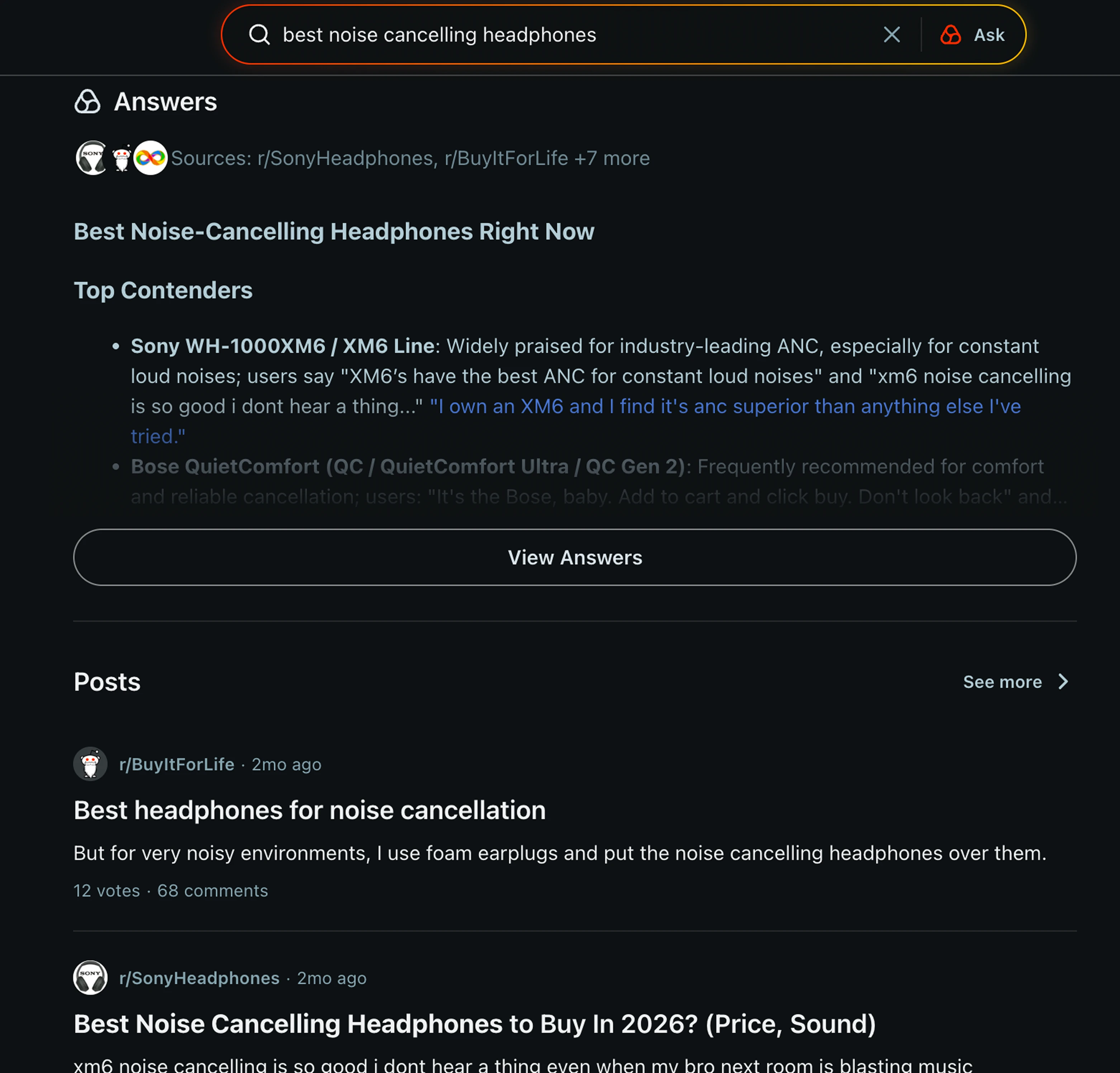
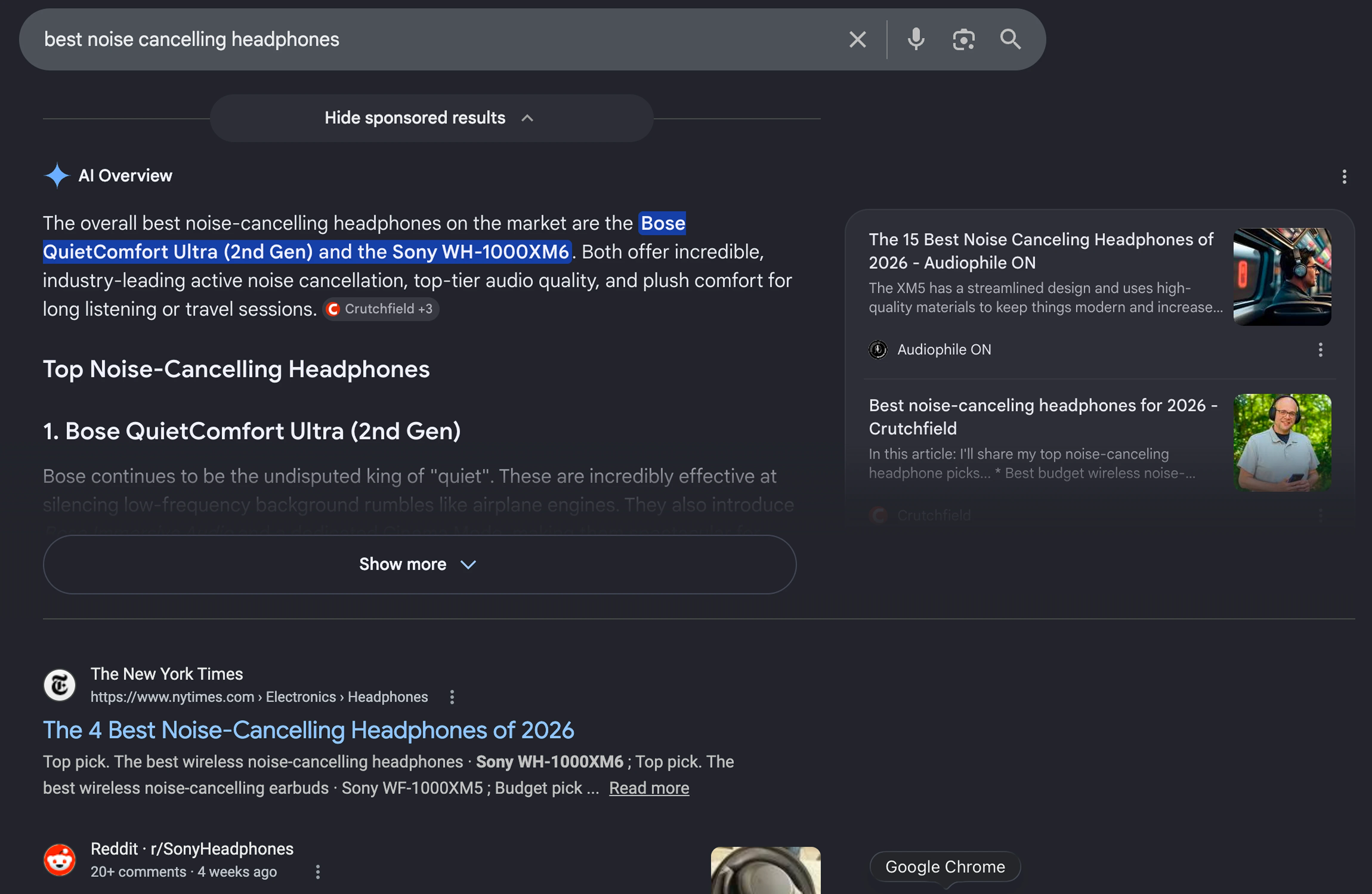
I built what leadership asked for, quick-tested it with clients, then showed the team what it was missing
I built a prototype of the proposed solution using Claude Code and presented it to our clients to see how they actually interacted with it. The feedback was clear: it surfaced some information but didn't help them act on it. I brought those findings back to the team, which shifted the conversation from whether the idea was good to what the experience actually needed to do.
It's a good start, but it doesn't solve the problem.
UX Decisions
UX Decision 1: Put the agent everywhere, not just the order page
Every page in Direct is made to have its content fit within a centered container. The consistent grid structure means any page can compress horizontally to make room for a side panel without breaking the experience. Nothing gets hidden or overlapped. The content simply adjusts within its container and the agent lives alongside it.
UX Decision 2: Show the agent thinking out loud
UX Decision 3: Show where agent finds its information from
UX Decision 4: Suggesting next steps
Design
Final Designs
AI Agent for Managing Orders in Direct.
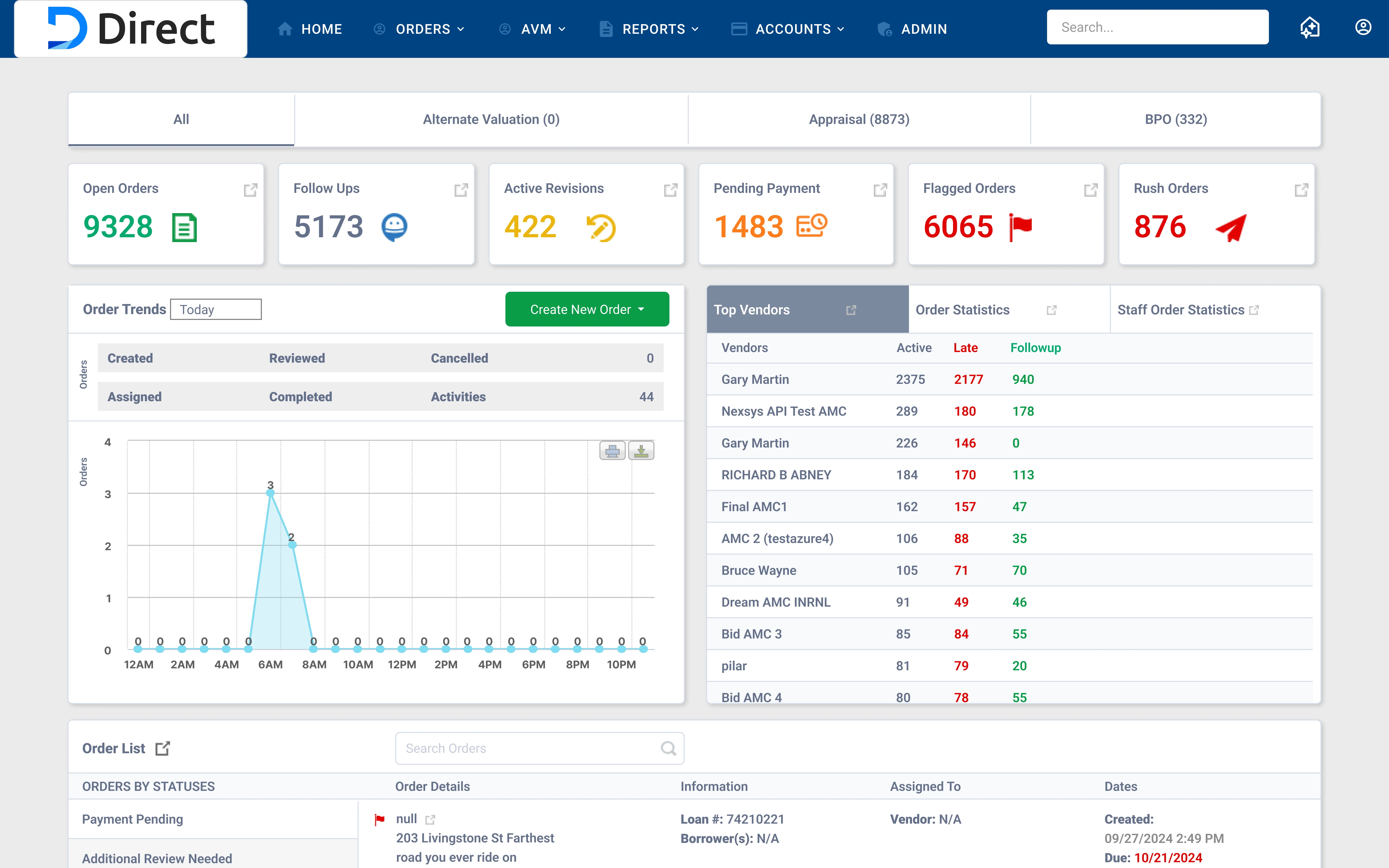
I did not design the Direct dashboard
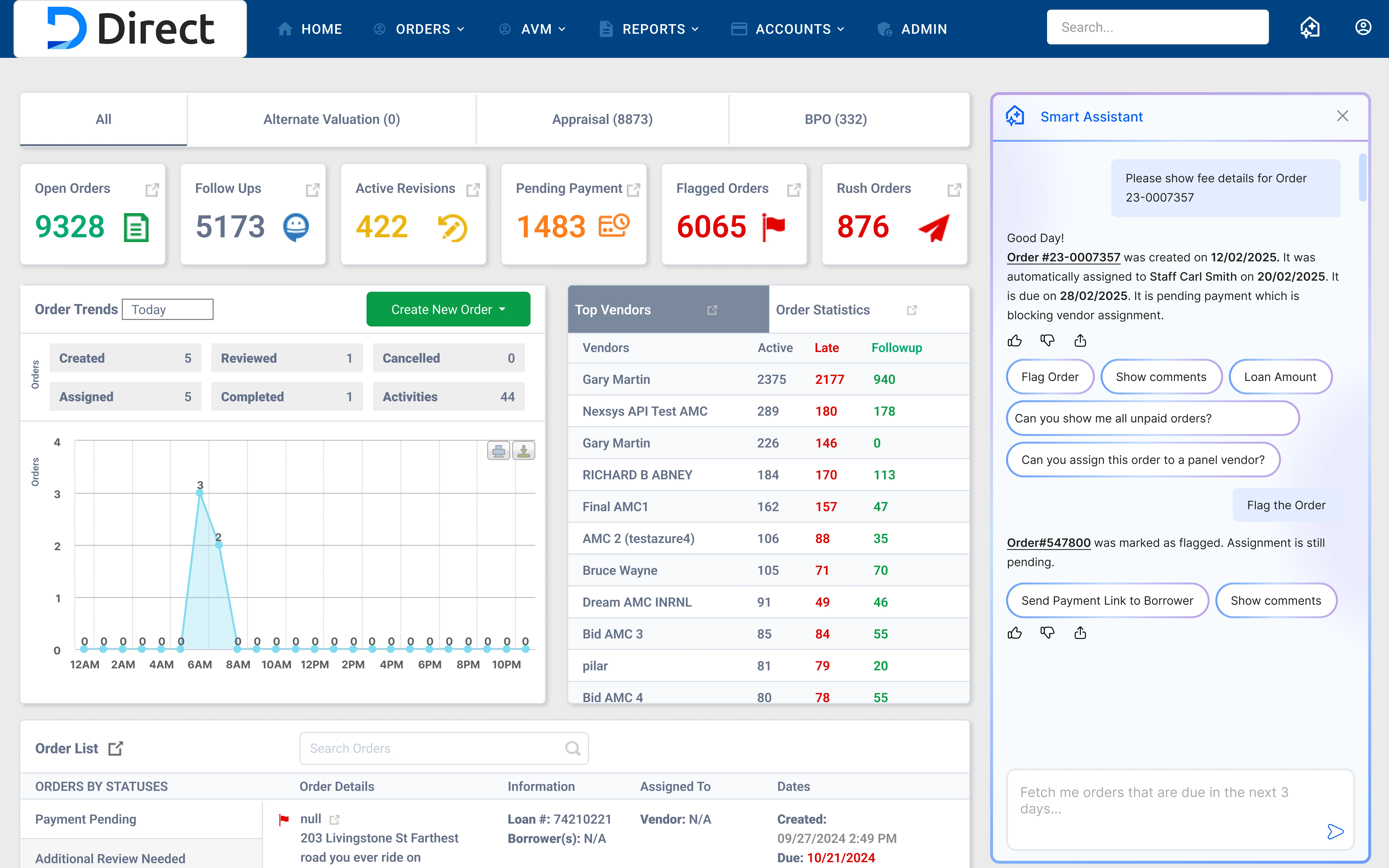
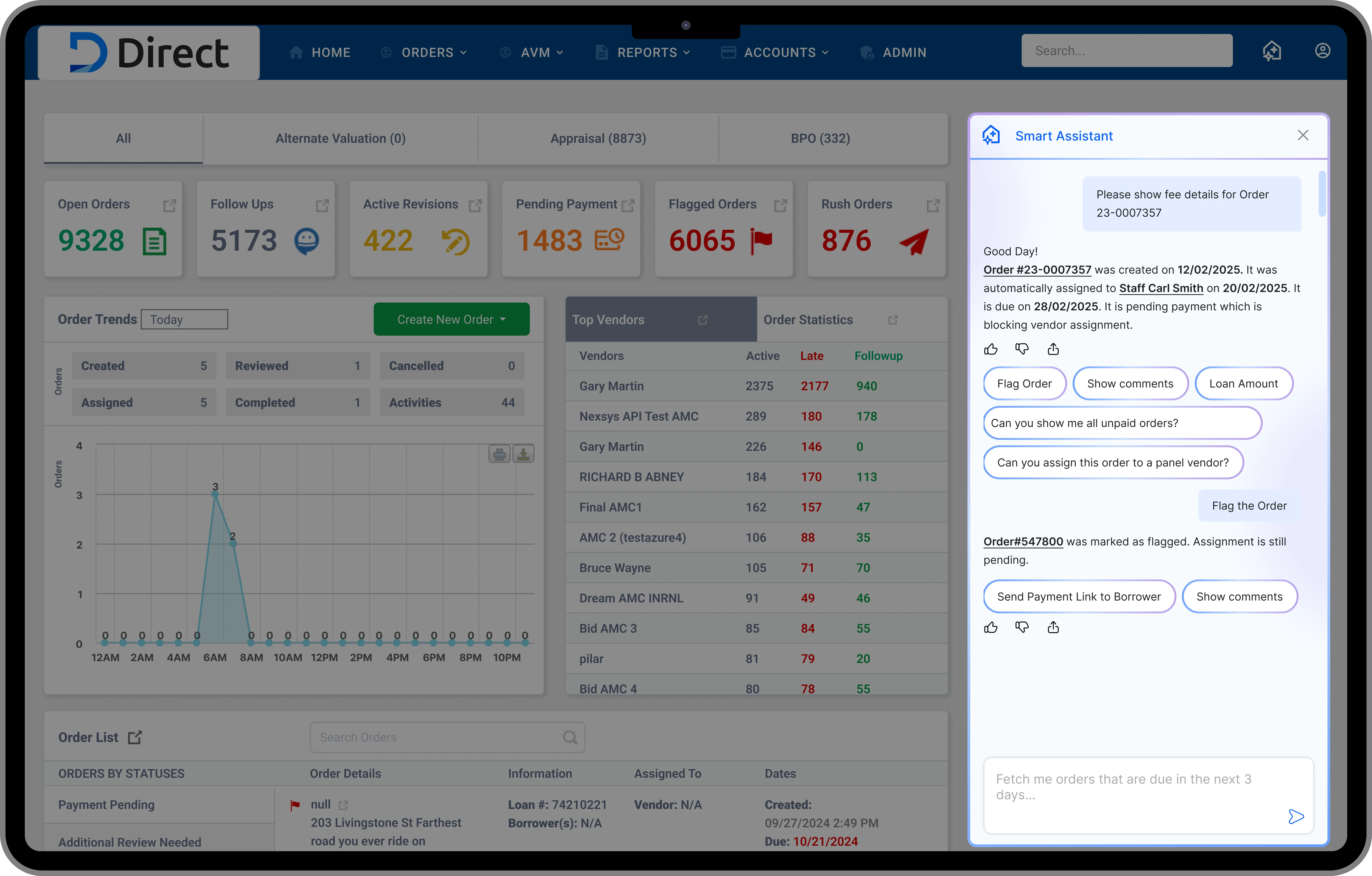
I designed the AI agent which opens when user clicks on the icon in top menu
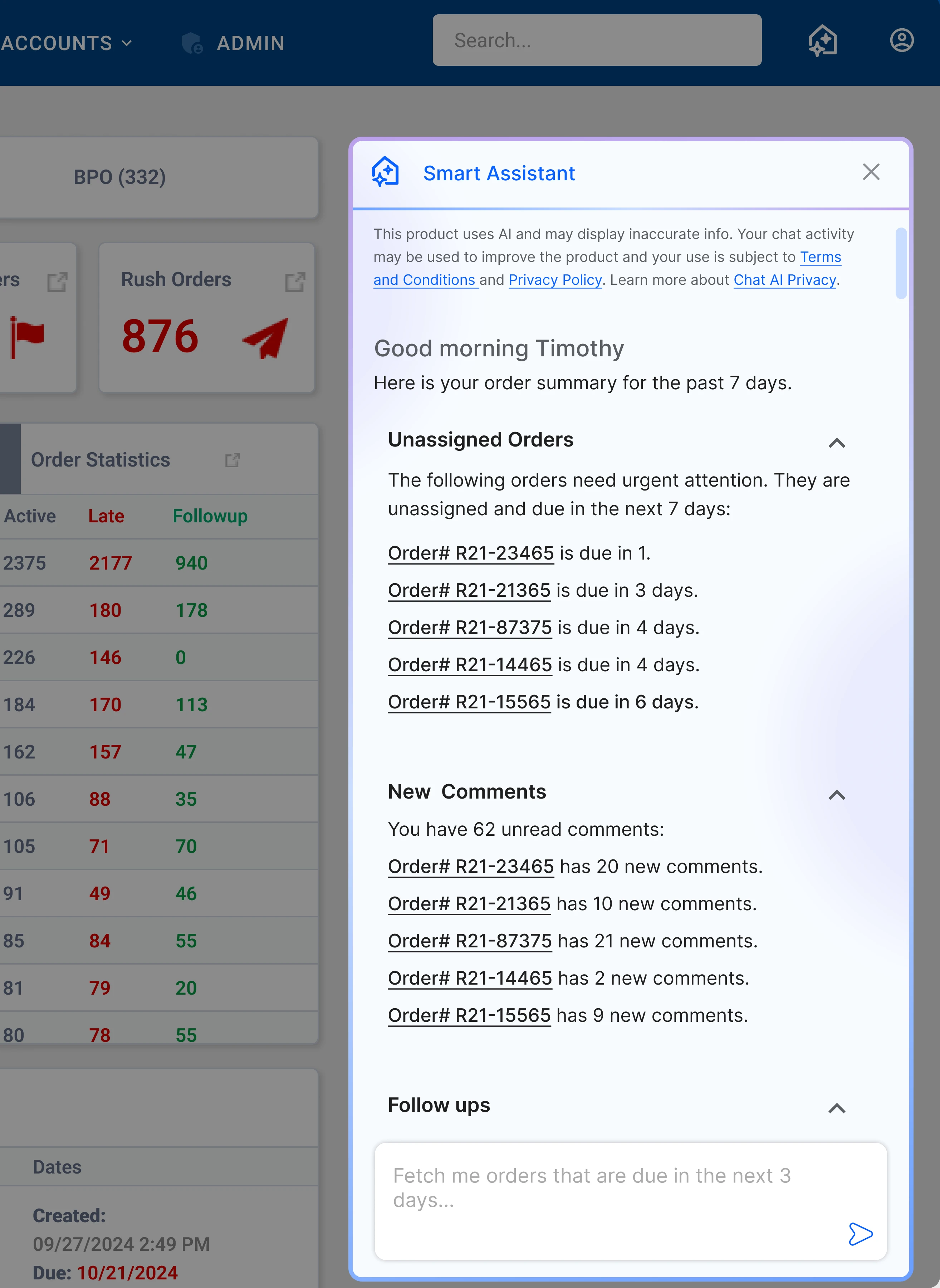
Welcome screen shows an overview of orders from the last 7 days
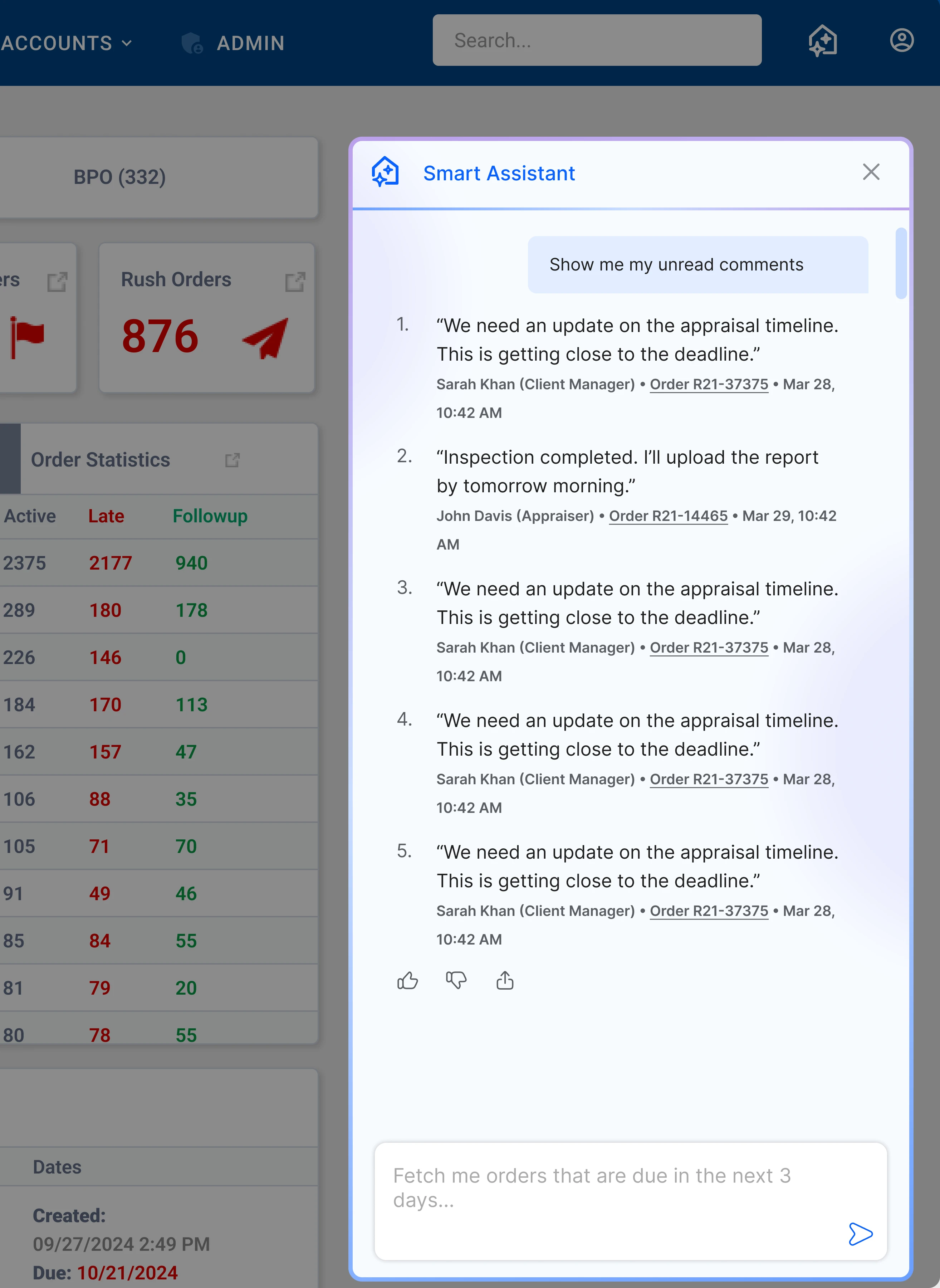
Example of user requesting to see unread comments
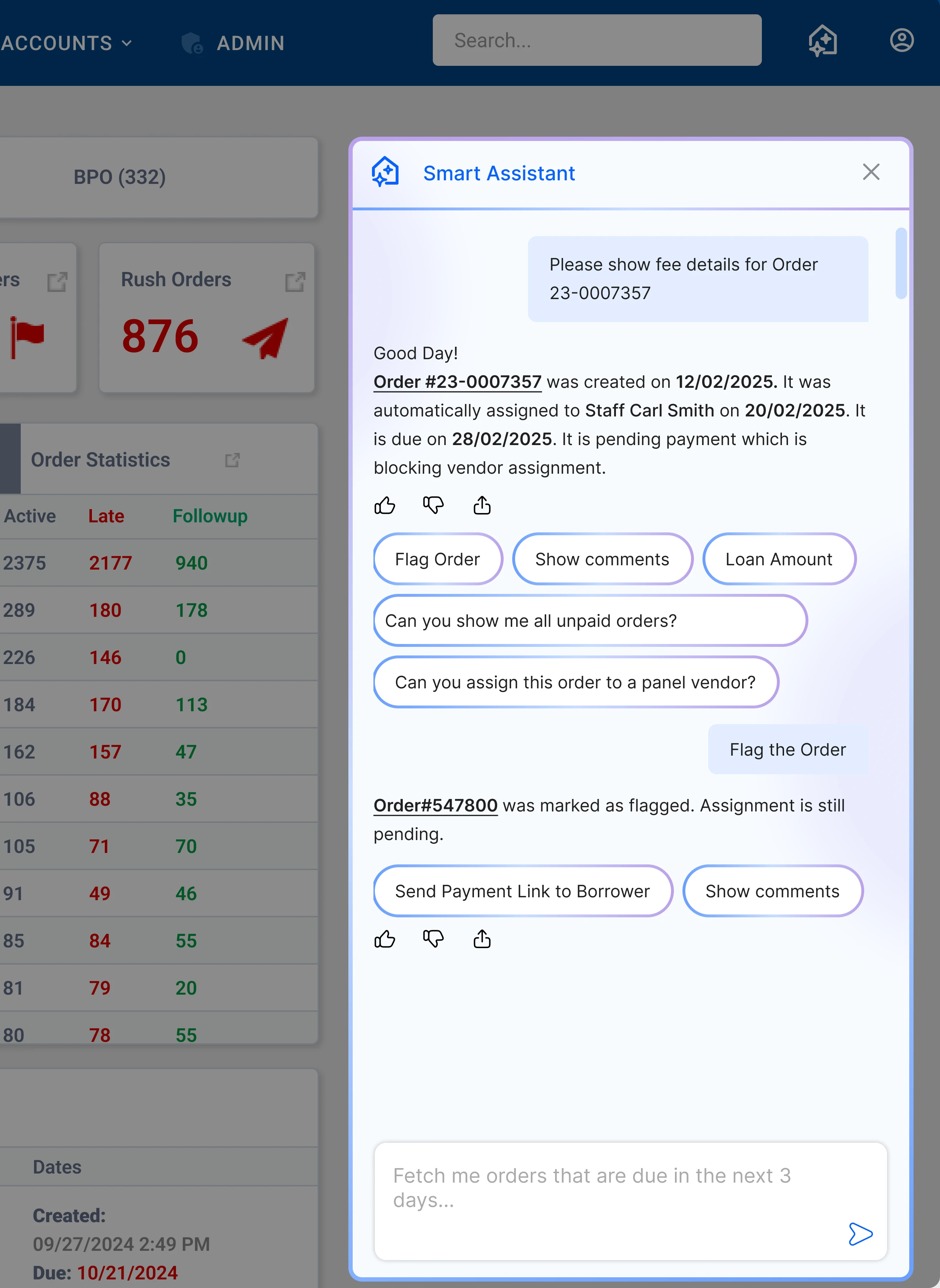
User can also ask specific questions about their orders or select from suggestions
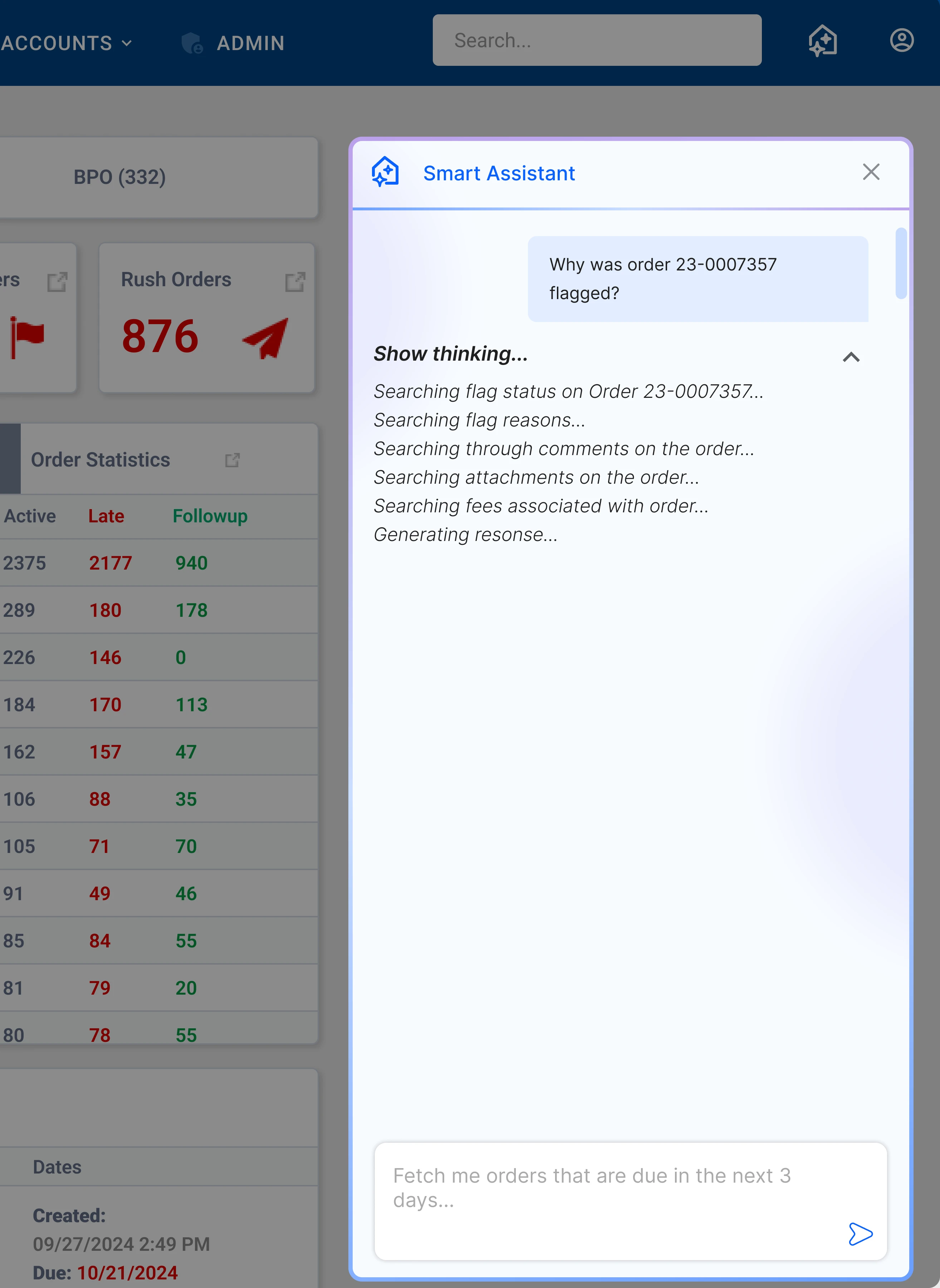
Shows the Agent's thought process to garner user trust
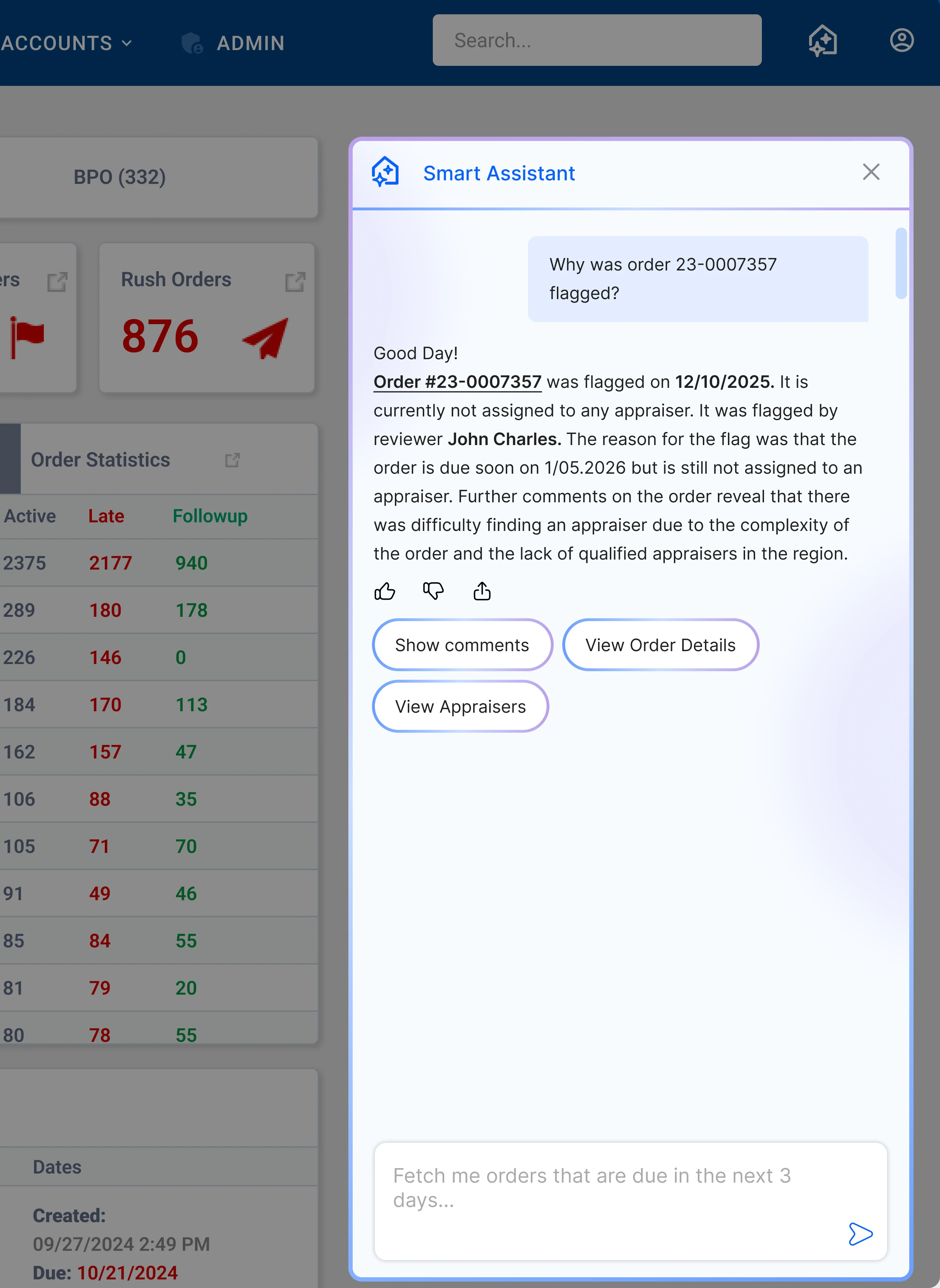
Example of chat with agent
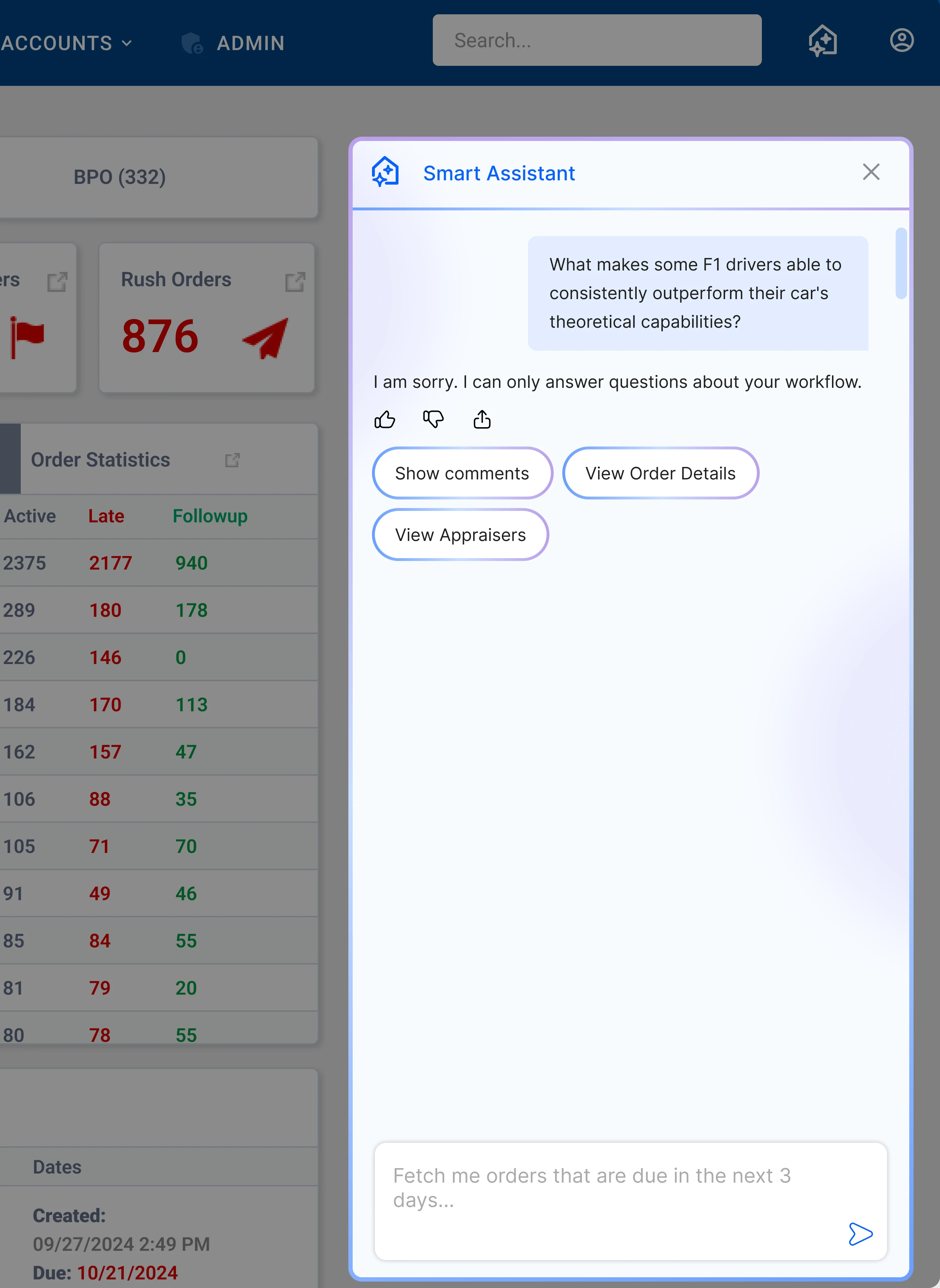
Example of user asking a question which is out of the agent's scope
Testing and Feedback
Putting it to the test
To ensure accuracy and usefulness in a high-stakes B2B environment, the agent was initially rolled out to a small group of clients rather than a full-scale launch. This allowed us to validate performance in real workflows while minimizing risk. It was then gradually rolled out to more clients after validation.
Rollout Approach
- 01Small group of clients
- 02Validate performance in real workflows
- 03Gradual full rollout after validation
- 04Continuous validation, feedback collection, and response improvement
Improving Conversations and Responses
I learned that when users wanted to know information about orders, they also wanted the agent to link the attached documents for that order in the chat, so that users don't have to look for it themselves and can just download it through the agent.
User Feedback
"We love using the chat that you guys have come out with. It makes order processing so much faster for us."
How I Monitored
I closely monitored Microsoft Clarity, Hotjar, and Mixpanel to analyze user engagement with the agent. I also sat down with clients to see what they had to say. This helped me improve responses.
How it changed Sarah's workflow
Before I had to constantly switch between tabs. Now, the agent gives me a centralized overview of orders due soon, so I don't have to jump between screens.
Before I tracked follow-ups manually. Now, it highlights orders that need attention so I can act without mentally tracking everything.
Before I kept losing track of my overall workload. Now, it gives me a quick summary of orders so I always know where things stand.

Before I had to rely on customer support for updates. Now, the agent instantly surfaces order statuses, reducing back-and-forth.
Before I had to read comments order by order. Now, it aggregates unread comments across orders so I can review everything in one place.
Before I kept breaking my workflow to find information. Now, the agent is embedded throughout Direct so I can access anything from anywhere.
Reflections
What I Learned
Think in systems
This required me to think in systems. The real complexity was in structuring modular services for user intent, order retrieval, and action execution (like performing actions within specific orders).
What I want to improve on
I want to give the agent the ability to answer questions about the constantly changing government regulations around appraisals and what it means for the user.
Results
Product Impact
Improvement in Order Completion
Drove a 35.2% reduction in order delays as noted by Mixpanel.
Decrease in Dependency
Decreased user dependency on Customer Success by 45.4%, freeing up Customer Success for other tasks and giving users more agency.
How we measured metrics
35.2% — Improvement in Order Completion
Tracked via Mixpanel event funnels. We defined an "order delay" as any order that stalled past its expected completion window. Before launch, Mixpanel showed a consistent delay rate; after the AI Workflow Agent shipped, we compared the same funnel over a 60-day post-launch window and observed a 35.2% reduction in stalled orders.
45.4% — Decrease in Customer Success Dependency
Measured by counting inbound Customer Success tickets and live-chat escalations related to order status and workflow questions. Before launch, CS fielded a high volume of these requests weekly. Post-launch, we pulled the same category of tickets from the support queue and saw a 45.4% drop, indicating users were resolving those questions directly through the agent.